Electronic Materials and Processes Handbook, Third Edition
Michael Carano
Electrochemicals, Inc.
Maple Plain, Minnesota
Joseph Fjelstad
Silicon Pipe, Inc.
San Jose, California
Of all of the elements of an electronic system, perhaps none is more essential than the printed circuit board. At the same time, however, no other element seems to be so underappreciated. Prior to the advent of the printed circuit, electrical interconnections between components were made in a point-to-point fashion. This was both very time consuming and highly error prone. The printed circuit offered a way to make ordered interconnections between components while radically reducing the potential for error by allowing faithful reproduction of the circuit using a combination of lithographic and etching methods. It has been that way virtually ever since.
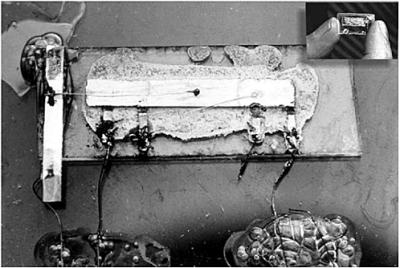
Today, it can be easily argued that the printed circuit is the foundation of almost all electronic products and systems and a technological marvel of immense dimensions, but it is commonly overshadowed but the more glamorous integrated circuit. Interestingly, the printed circuit is likely to have served as the inspiration for the inventors of the IC, given that the concepts described by both Jack Kilby and Robert Noice appear to have borrowed from printed circuit manufacturing methods. Kilby had, in fact, joined pioneering printed circuit company, Centralab, in Milwaukee, WI, in 1947 after leaving college. Figure 7.1 shows first Kilby s IC. Regardless, the printed circuit will assuredly remain an indispensable element of electronics for many years to come.