Electronic Materials and Processes Handbook, Third Edition
Thick film resistors are formed by mixing metal oxide particles with glass particles and firing the mixture at a temperature/time combination sufficient to melt the glass and sinter the oxide particles together. The resulting structure consists of a series of three-dimensional chains of metal oxide particles embedded in a glass matrix. The higher the metal oxide-to-glass ratio, the lower will be the resistivity of the fired film and vice versa.
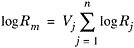
Thick film resistor materials are blended approximately to Lichtenecker s logarithmic mixing rule,
| (8.21) | |
where R m = bulk resistivity of the mixture
V j = volume fraction of the individual component
R j = bulk resistivity of the component
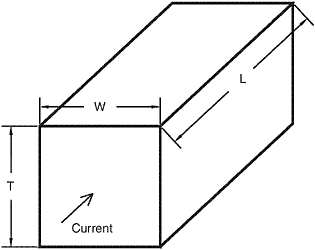
Referring to Fig. 8.20, the electrical resistance of a material in the shape of a rectangular solid is given by the classic formula,
| (8.22) | |
where R = electrical resistance in ohms
? B = bulk resistivity of the material in ohms-length
L = length of the sample in the appropriate units
W = width of the sample in the appropriate units
T = thickness of...