Electronics Technology Handbook

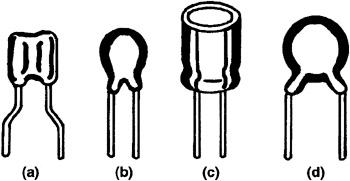
A passive electronic component is a circuit part that functions without an external power requirement. The most common passive components are resistors, capacitors, and inductors. Most of them have two leads. An axial-leaded component, as shown in Fig. 1-1, has leads projecting from each end of the component body aligned with the long axis of the part, while a radial-leaded component, as shown in Fig. 1-2, has parallel leads projecting at right angles from its body. Axial leads must first be bent 90 to insert them into the holes of circuit boards, while radial leads can typically be inserted directly into those holes without bending. However, both axial- and radial-leaded parts can be inserted by automatic machines.
The ongoing trend toward more surface mounting of electronic components has led to the introduction of more active and passive "leadless" components that can be soldered directly to tinned or plated pads on "hole-less" or surface-mount technology (SMT) circuit boards. Passive SMT components such as capacitors and resistors are leadless rectangular chips or cylinders with metallized end surfaces that are reflow soldered to the circuit boards, but many active components, such as transistors and integrated circuits, are in cases with bent stub or "gull wing" leads that can also be reflow soldered...