Engineering Computations: International Journal for Computer-Aided Engineering and Software: The Discrete Element Method: Numerical Modelling of Discontinua, Volume 21, Number 2/3/4, 2004

Bins are used to fulfil a range of functions; acting as an interchange between different conveyor belts, providing buffers for downstream processing plants and enabling incoming streams to be divided into multiple outgoing streams. An important consideration is whether the material on the different outgoing belts is the same or whether compositional changes have been induced by the operation of the bin.
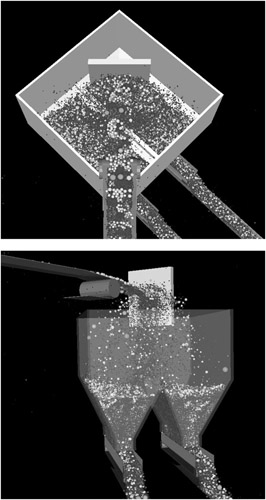
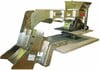
Figure 3 shows a complex splitter bin system modelled using DEM. The incoming conveyor is oriented at 45 to the bin and transports particles to the bin (with a 6 m square top and 6 m height). The stream separates from the head pulley and travels on a parabolic trajectory over the bin where it is deflected downwards by a large central impact plate. The lower half of the bin is split into two parts by a splitter plate and each side converges to form a long slot hopper. Each hopper then discharges onto an apron feeder that draws out material. This then falls onto smaller outgoing conveyor belts.
The incoming stream is commonly vertically segregated during its motion on the conveyor with the fines migrating to the bottom. The upper part of the stream hitting the impact plate (composed of coarse particles) is deflected upwards and to the sides forming a dense parabolic concentration of particles above the impact point which in turn produces a distinctly separate...