Engineering Computations: International Journal for Computer-Aided Engineering and Software: The Discrete Element Method: Numerical Modelling of Discontinua, Volume 21, Number 2/3/4, 2004

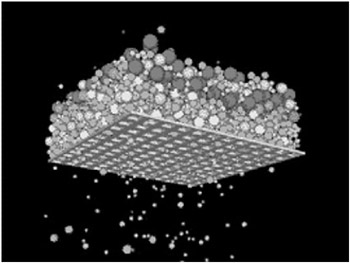
Particle separation using vibrating screens is a common method for dividing particles into a product stream and a recycle stream. The efficiency of the screen is determined by the size and shape of the screen openings and the amplitude and frequency of the screen motion. DEM allows screen efficiency to be easily evaluated. Figure 7 shows an example of an 800 mm 2 section of a screen deck oscillating diagonally upwards (and slightly sideways at around 4 Hz). This frequency is enough to generate significant motion of the bed, which separates from the screen at the extreme points of its motion. The bed then crashes down onto the screen producing a pulse of fine particles that are able to move through the holes in the screen. The rate of separation can be limited by both ability of the smaller particles to pass through the openings and percolation rate of these particles through the bed above.
Wear patterns and relative rates of wear can be predicted to estimate the life span of the screen or the rate of damage to any protective coating (for example, a polyurethane or a ceramic liner). Rates of accretion of cohesive fines can also be estimated. In both cases, the geometry of the screen can be evolved dynamically during the simulation to predict the change in the open area of the screen and its effects on...