Engineering Formulas For Metalcutting

Dynamics is described by formulas showing how the cutting forces, torque, and machining power depend on mechanical properties of work materials and the cutting conditions. Parameters of dynamics are:
Tangential force
Power constants
Feed and radial forces
Torque at the cutting tool
Machining power at the cutting tool
Machining power at the motor.
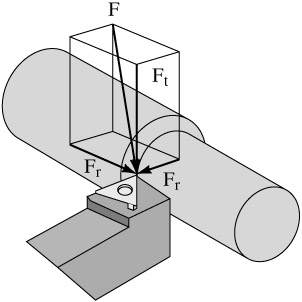
Engagement of the cutting edge with the rotating workpiece at a given depth of cut and feed rate generates a cutting force. This force undercuts a layer of material and separates it from a workpiece in the form of chips. Such a cutting force ( F) combines tangential ( F t), feed ( F f), and radial ( F r) forces, which could be measured by a three-component dynamometer (Fig. 10). Of the three cutting force components, tangential, feed, and radial, the tangential force is the greatest.
Tangential force generates torque at the spindle and accounts for more than 95% of the machining power. Therefore, it is very important to know how the tangential force can be calculated. The following is a step-by-step derivation of the formula to calculate the tangential force.
The relationship between tangential force ( F t), cutting speed ( V c), and power at the cutting tool ( P c) can be expressed in customary U.S. units of measure as:
| (3.30) |