Engineering Formulas For Metalcutting

Boring is an internal turning operation performed with a boring bar to enlarge a previously drilled hole to form an internal shape of required dimensions. Boring operations range from semiroughing to finishing.
The majority of formulas described in Chapter 3 "Turning" are applicable to "Boring". Some formulas were modified and a few new formulas were developed.
Insert identification systems described in sections 3.1.1 and 3.1.2 are applicable to boring as well.
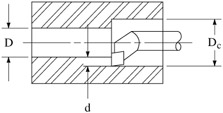
Formulas given in section 3.2 "Kinematics and Productivity" are valid for boring. To calculate cutting speed and spindle speed, formulas (3.1) through (3.4) should be used. When applied to boring, symbol D in these formulas means "internal workpiece diameter". When calculating feed speed and metal removal rate, formulas (3.5), (3.7), and (3.8) can be used with the same symbols. Depth of cut ( d) can be calculated by formula (3.6) modified for boring:
| (4.1) | |
where
D c is the workpiece cut inside diameter,
D is the workpiece uncut inside diameter. When boring, D c > D (Fig. 11).
Figure 11: Depth of cut when boring
Formula (3.9) is recommended to calculate machining time in boring operations. Formula (3.27) can be used for calculating machining time when grooving. Machining time formulas when facing and cutting off are not applicable to boring, because the cutting tools (boring bars) cannot be fed perpendicular to the centerline of the workpiece.
Tangential force formulas and the power constant data (sections 3.3.1 and 3.3.2) are valid...