Engineering Mechanics of Composite Materials

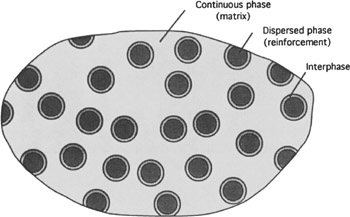
A structural composite is a material system consisting of two or more phase on a macroscopic scale, whose mechanical performance and properties are designed to be superior to those of the constituent materials acting independently. One of the phases is usually discontinuous, stiffer, and stronger and is called reinforcement, whereas the less stiff and weaker phase is continuous and is called matrix (Fig. 1.1). Sometimes, because of chemical interactions or other processing effects, an additional phase, called interphase, exists between the reinforcement and the matrix. The properties of a composite material depend on the properties of the constituents, geometry, and distribution of the phases. One of the most important parameters is the volume (or weight) fraction of reinforcement, or fiber volume ratio. The distribution of the reinforcement determines the homogeneity or uniformity of the material system. The more nonuniform is the reinforcement distribution, the more heterogeneous is the material and the higher is the probability of failure in the weakest areas. The geometry and orientation of the reinforcement affect the anisotropy of the system.
The phases of the composite system have different roles that depend on the type and application of the composite material. In the case of low to medium performance composite materials, the reinforcement, usually in the form of short fibers or particles, provides some stiffening but only local strenghening of the material. The matrix, on the other hand, is the main load-bearing constituent...