3.1.1 General Anisotropic Material
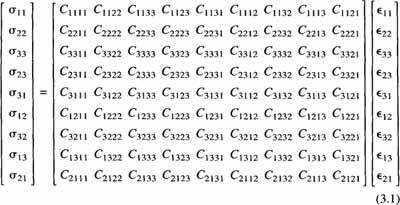
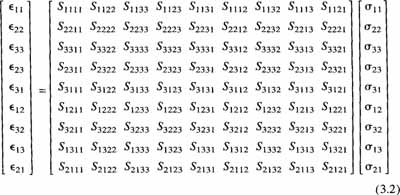
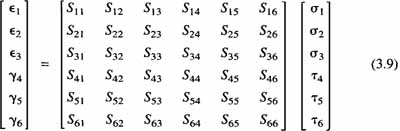
The state of stress at a point in a general continuum can be represented by nine stress components ? ij (where i, j = 1, 2, 3) acting on the sides of an elemental cube with sides parallel to the axes 1, 2, 3 of a reference coordinate system (Fig. 3.1). Similarly, the state of deformation is represented by nine strain components, ? ij. In the most general case the stress and strain components are related by the generalized Hooke's law as follows:
and
 Figure 3.1: State of stress at a point of a continuum.
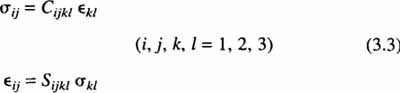
 or, in indication notation
where
| C ijkl = | Stiffness components |
| S ijkl = | Compliance components |
Repeated subscripts in the relations above imply summation for all values of that subscript. The compliance matrix [ S ijkl] is the inverse of the stiffness matrix [ C ijkl].
Thus, in general, it would require 81 elastic constants to characterize a material fully. However, the symmetry of the stress and strain tensors
reduces the number of independent elastic constants to 36.
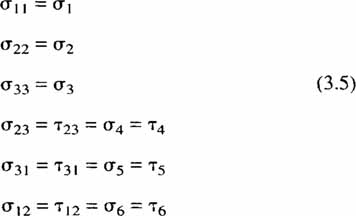
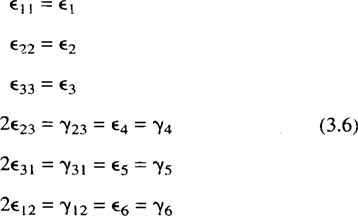
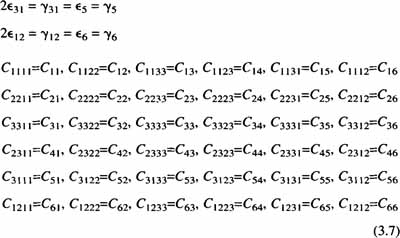
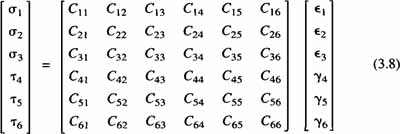
It is customary in mechanics of composites to use a contracted notation for the stress, strain, stiffness, and compliance tensors as follows:
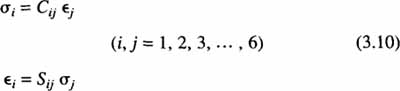
Thus the stress strain relations for an anisotropic body can be written in the contracted notation as
or, in indicial notation,
Energy considerations require additional symmetries. The work per unit volume is expressed as
The stress strain relation, Eq. (3.10), can be obtained...


 TABLE OF CONTENTS