Engineering Mechanics of Composite Materials

Constituent properties are important for understanding and predicting the macroscopic behavior of composite materials by means of micromechanics. These include physical and mechanical properties of fibers and matrices.
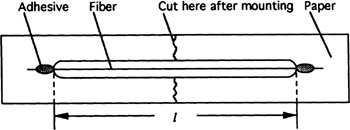
The most commonly measured properties of fibers are the longitudinal modulus, tensile strength, and ultimate tensile strain. [5], [6], [7], [8] A mechanical test method is described in ASTM specification D3379-75. [5] The method is recommended for fibers with an elastic modulus greater than 21 GPa (3 Msi). The filament is mounted along the centerline of a slotted paper tab and axial alignment is accomplished without damaging the fiber (Fig. 8.1). After the specimen is mounted in the test machine the paper tab is cut to allow for filament elongation. Specimens of various gage lengths are tested to failure at a constant crosshead rate, and the load-displacement curve is obtained.
To determine the elastic modulus of the fiber, the measured load displacement curves must be corrected for the system compliance. The measured or "apparent" compliance is assumed to be the sum of the fiber and system compliances.
where
| C a = | Apparent compliance |
| u = | Crosshead displacement |
| u f | = Actual fiber elongation |
| u s | = Displacement due to system compliance |
| P = | Load |
| l = | Fiber gage length |
| E 1 f = | Longitudinal fiber modulus |
The system compliance, C s