Engineering Physics: Fundamentals and Modern Applications

4.10: DIVISION OF WAVEFRONT

4.10 DIVISION OF WAVEFRONT

Theory of Interference Fringes

Let S be a narrow slit illuminated by monochromatic light of wavelength ?, and S 1 and S 2 be the two narrow slits separated by a small distance 2 d (as in Figure 5). Let a screen XY be placed at a distance D from the coherent sources S 1 and S 2. Let O be the foot of the perpendicular drawn from C, the mid point of S 1 and S 2 on the screen. Now consider a point P on the screen at a distance x from O at which the condition for bright and dark fringes are to be determined. Draw S 1M and S 2N perpendiculars from S 1 and S 2 on the screen and join S 1P and S 2P. The path difference between the waves reaching at P from S 1 and S 2 is given by


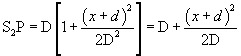
In a right angled triangle S 2NP, we have


Figure 5

Using the binomial theorem and neglecting higher terms, since D >> x or d, we get

(1)

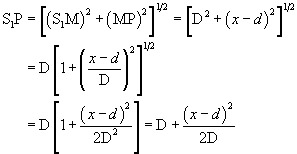
Similarly in a right angled triangle S 1MP, we have

(2)

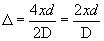
? Path difference,


(3)

If the sources S 1 and S 2 are in the same phase as the waves reaching at P, the path differences must only be due to path difference, ?

UNLIMITED FREE
ACCESS
TO THE WORLD'S BEST IDEAS

SUBMIT
Already a GlobalSpec user? Log in.

This is embarrasing...

An error occurred while processing the form. Please try again in a few minutes.

Customize Your GlobalSpec Experience

Category: Optical Apertures
Finish!
Privacy Policy

This is embarrasing...

An error occurred while processing the form. Please try again in a few minutes.