Engineering Physics: Fundamentals and Modern Applications

4.11: FRESNEL'S BIPRISM

4.11 FRESNEL'S BIPRISM

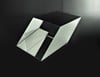
Fresnel produced the interference fringes in the laboratory by deriving two coherent sources S 1 and S 2 from a single monochromatic source S by using the deviation produced by a biprism. The experimental arrangement is shown schematically in Figure 7. The biprism consists of two acute angled prisms with their bases in contact. It is actually a single prism of an obtuse angle of about 179 . The acute angle ? on both sides is about 30' (or 1/2 ). The prism is placed with its refracting edge parallel to the slits such that SE is normal to the face GF of the prism. Light from a narrow vertical slit S, illuminated with monochromatic light of wavelength ?, is allowed to fall symmetrically on the biprism. When light falls from S on the lower half of the prism, it bends upwards and appears to come from S 2. Similarly the light from S, which falls on the upper half of the prism, is bent downwards and appears to come from S 1. The virtual images S 1 and S 2, being the images of S, act as two coherent sources. The source S 1 illuminates the portion AQ of the screen while the source S 2 illuminates the portion BP. In the common shaded region the coherent beams overlap and therefore interfere. In the region AB the interference fringes have equal width, but beyond A and B the...

UNLIMITED FREE
ACCESS
TO THE WORLD'S BEST IDEAS

SUBMIT
Already a GlobalSpec user? Log in.

This is embarrasing...

An error occurred while processing the form. Please try again in a few minutes.

Customize Your GlobalSpec Experience

Category: Optical Prisms
Finish!
Privacy Policy

This is embarrasing...

An error occurred while processing the form. Please try again in a few minutes.