Engineering Physics: Fundamentals and Modern Applications

Chapter 5: Diffraction of Light

5.1 OVERVIEW

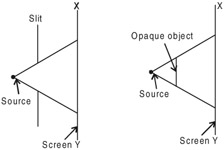
We have seen that the interference phenomenon arises due to two or more coherent beams of light obtained either by wavefront division or by amplitude division or both. In this chapter, we shall deal with the interference phenomenon occurring between light beams from various parts of one aperture. Ordinarily, when a plane wave of light is incident on a long narrow slit placed in front of a screen, a sharp patch of light and a shadow is obtained on the screen (as shown in Figure 1). This shows that the light travels approximately in straight lines. But a very close examination of the light distribution on the screen reveals dark and bright fringes near the edges. It is observed that, if the aperture reduces in width, the patch of light on the screen becomes distinctly wider than given by laws of geometrical optics, and the fringes become more and more distinct until they become broad and practically cover the entire patch. Similarly, when an opaque obstacle is placed in the path of light, instead of a sharp shadow, bright and dark fringes are obtained on the screen. This observation can be explained by assuming that light waves bend around an obstacle. The amount of bending, however, depends upon the size of the obstacle and the wavelength of the wave.


Figure 1: Bending of light at edges.

Thus we see when light passes through a small opening (or aperture) or by the side of a small obstacle, it bends,...

UNLIMITED FREE
ACCESS
TO THE WORLD'S BEST IDEAS

SUBMIT
Already a GlobalSpec user? Log in.

This is embarrasing...

An error occurred while processing the form. Please try again in a few minutes.

Customize Your GlobalSpec Experience

Category: Interferometers
Finish!
Privacy Policy

This is embarrasing...

An error occurred while processing the form. Please try again in a few minutes.