Environmental Engineering Problems and Solutions

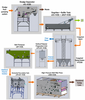
Sludge processing prior to final disposal may be divided into the following unit operations: thickening, stabilization, conditioning, dewatering, and thermal reduction.
Identify several processes commonly associated with each unit operation.
Identify the type of sludge or process most applicable to each of the sludge thickening alternatives identified in (a).
List the relative advantages and disadvantages of anaerobic and aerobic digestion.
Thickening
Gravity Thickening
Dissolved Air Flotation
Centrifuge
Stabilization
Anaerobic Digestion
Aerobic Digestion
Lime Treatment
Composting
Conditioning
Chemical Conditioning
Conditioning
Heat Treatment
Dewatering
Rotary Vacuum Filter
Centrifuge
Belt Filter Press
Pressure Filter
Drying Beds
Lagoons
Thermal Reduction
Incineration
Wet Air Oxidation
Gravity thickening is generally best suited for treatment of primary sludge or combined primary and trickling filter sludge. Gravity thickening may be applicable to activated sludge or combined primary and activated sludge. Polymer or other flocculants are generally used in such cases to improve thickening.
Dissolved air flotation is generally used for waste activated sludge. Polymers are often used to improve solids capture and degree of solids concentration.
Centrifuges are generally used for waste activated sludge or industrial sludges that are difficult to dewater.
Anaerobic Digestion
| Advantages | Disadvantages |
|---|---|
| Methane gas production | Requires close process control |
| High organic loadings possible | External heat required |
| Low solids production | Supernatant requires treatment |
| Reduction of volatile organic matter | High capital cost |
Aerobic Digestion
| Advantages | Disadvantages |
|---|---|
| Supplemental heating usually not required | Higher operating cost |
| Relatively easy to operate | |
| Does not generate significant odors | Requires energy input for aeration |
| Supernatant of relatively good... |