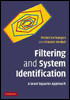
Filtering and System Identification: A Least Squares Approach
After studying this chapter you will be able to
derive the data equation that relates block Hankel matrices constructed from input-output data;
exploit the special structure of the data equation for impulse input signals to identify a state-space model via subspace methods;
use subspace identification for general input signals;
use instrumental variables in subspace identification to deal with process and measurement noise;
derive subspace identification schemes for various noise models;
use the RQ factorization for a computationally efficient implementation of subspace identification schemes; and
relate different subspace identification schemes via the solution of a least-squares problem.