Filtering and System Identification: A Least Squares Approach

To get a consistent estimate of the system matrices, all the subspace identification schemes presented in the previous sections require that the input of the system to be identified is uncorrelated with the additive perturbation ?(k) to the output. We refer, for example, to Theorems 9.3, 9.4, and 9.5.
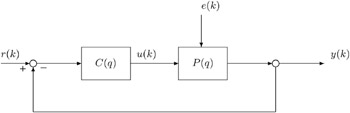
This assumption on the input is easily violated when the data are acquired in a closed-loop configuration as illustrated in Figure 9.9. The problems caused by such a closed-loop experiment should be addressed for each identification method individually. To illustrate this, we consider the subspace identification method based on Theorem 9.5. The result is summarized in our final theorem of this chapter.
Theorem 9.7 Consider the system P in Figure 9.9 given by (9.50) and (9.51) with x(k), u(k), and e(k) ergodic stochastic processes and e(k) a zero-mean white-noise sequence e(k). The controller C is causal and the loop gain contains at least one sample delay. Take the instrumental- variable matrix Z N equal to
then
Proof The data equation for the plant P in innovation form reads
Because of the white-noise property of e(k), the closed-loop configuration, and the causality of the controller C, the state x(k) and the input u(k) satisfy
By virtue of the ergodicity of...