Filtering and System Identification: A Least Squares Approach

9.2: Subspace Model Identification for Deterministic Systems

9.2 Subspace Model Identification for Deterministic Systems

The subspace identification problem is formulated for deterministic LTI systems, that is, LTI systems that are not disturbed by noise. Let such a system be given by


where x(k) ? n, u(k) ? m, and y(k) ? ?.

Given a finite number of samples of the input signal u(k) and the output signal y(k) of the minimal (reachable and observable) system (9.1) (9.2), the goal is to determine the system matrices (A, B, C, D) and initial state vector up to a similarity transformation.

An important and critical step prior to the design (and use) of subspace identification algorithms is to find an appropriate relationship between the measured data sequences and the matrices that define the model. This relation will be derived in Section 9.2.1. We proceed by describing subspace identification for an autonomous system (Section 9.2.2) and for the special case when the input is an impulse sequence (Section 9.2.3). Finally, we describe subspace identification for more general input sequences (Section 9.2.4).

9.2.1 The data equation

In Section 3.4.2 we showed that the state of the system (9.1) (9.2) with initial state x(0) at time instant k is given by


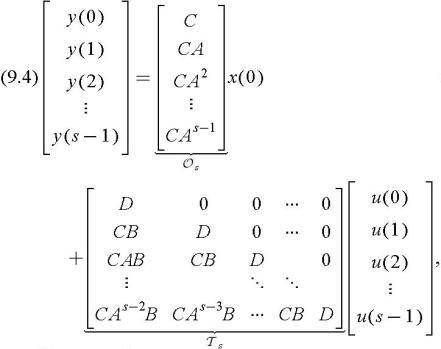
By invoking Equation (9.2), we can specify the following relationship between the input data batch and the output data batch :


where s is some arbitrary positive integer. To use this relation in subspace identification, it is necessary to take s > n,

UNLIMITED FREE
ACCESS
TO THE WORLD'S BEST IDEAS

SUBMIT
Already a GlobalSpec user? Log in.

This is embarrasing...

An error occurred while processing the form. Please try again in a few minutes.

Customize Your GlobalSpec Experience

Category: Nesting Software
Finish!
Privacy Policy

This is embarrasing...

An error occurred while processing the form. Please try again in a few minutes.