9.6 Subspace Identification with Process and Measurement Noise
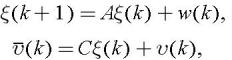
We now turn to the identification problem considered in Chapter 8. The refinement with respect to the previous section is that the noise ?(k) in (9.26) and (9.27) is obtained by filtering white-noise sequences as follows:
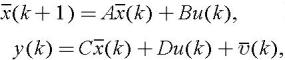
Throughout this section we assume that the process noise w(k) and the measurement noise ?(k) are zero-mean white-noise sequences that are uncorrelated with the input u(k). The relationship between the above signal-generating system and the system (9.26) (9.27) can be made more explicit if we write the system (9.48) (9.49) as
where ? (k) is given by
with ?(k)=  (k) ? x (k). Hence,
from which we clearly see that ? (k) is a colored-noise sequence.
When we consider only the input-output transfer of the systems under investigation, we can formulate (9.48) and (9.49) in innovation form as in Section 8.2:
where the innovation e(k) is a white-noise sequence and K is the Kalman gain.
Using the system representation (9.50) (9.51), we can relate the block Hankel matrices U i,s,N and Y i,s,N constructed from input-output data by the following data equation:
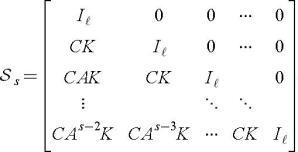
where E i,s,N is a block Hankel matrix constructed from the sequence e(k), and
describes the weighting matrix of the block Hankel matrix E i,s,N.
In a subspace identification framework the solution to the identification problem considered in Section 8.2 starts with the estimation of the column space of the...


 TABLE OF CONTENTS