The Finite Element Method for Electromagnetic Modeling

Written by specialists of modeling in electromagnetism, this book provides a comprehensive review of the finite element method for low frequency applications.
 TABLE OF CONTENTS
 We will again be interested in a problem of electrostatics, but this time of a 2D nature, in order to handle a more realistic example of implementation of the finite element method. We will find the differential then the variational forms of this type of problem, with the associated boundary conditions. We will present the general concepts of domain meshing and finite element interpolation. We will explain the Ritz method and we will implement it to find an approximate solution to the problem. Lastly, we will see how to take advantage of this solution to obtain local and global information that is more explicit than a simple set of nodal values.
The studied device is a condenser whose cross-section is represented in Figure 1-5 and whose depth h is very large in front of the section dimensions.
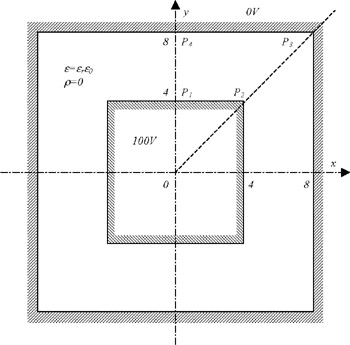
This condenser is composed of two overlapped conductors of square sections, one with the electric potential of 10V and the other with the potential of 0V. Taking into account the high dimension of the condenser in the direction perpendicular to the xOy plane, the 2D study of the device in its cross-section will give a very good idea of its global behavior. In fact, we are interested here in the capacitor of this condenser, which we will obtain by using the finite element method. For this...