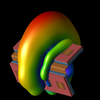
The Finite Element Method for Electromagnetic Modeling

Written by specialists of modeling in electromagnetism, this book provides a comprehensive review of the finite element method for low frequency applications.
 TABLE OF CONTENTS
 A formulation is considered "mixed" when it involves at least two unknown variables at the same point, for example, two fields, or one field and one potential. When the finite element method involves two unknown variables, one being defined within the elements and the other existing only on their interfaces facets of 3D elements then it involves a hybrid method.
This type of formulation has been developed primarily for applications that require the determination of several quantities: constraints and displacements in structural mechanics, velocity and pressure in fluid mechanics.
The value of mixed methods also derives from the fact that they can take full advantage of the benefit given by the variational approach: transposing some fundamental laws of physics to the discrete problem. A classical variational formulation, after discretization by finite elements, is the equivalent of seeking a configuration that minimizes functional calculus related to the discrete energy while mixed finite element methods can usually minimize the energy itself: complementary energy or Hellinger-Reissner energy in mechanics [QUA 97], and electromagnetic energy in the case of the Maxwell equations. In a sense, they provide a better description of physical laws.
[1]
For electromagnetism, the interest of simultaneous determination of two quantities such as the magnetic field h, and the vector potential a, or the magnetic induction b and scalar potential ? is not obvious. The second unknown variable, which does not bring a priori any additional information, significantly increases the number of...