The Finite Element Method for Electromagnetic Modeling

Written by specialists of modeling in electromagnetism, this book provides a comprehensive review of the finite element method for low frequency applications.
 TABLE OF CONTENTS
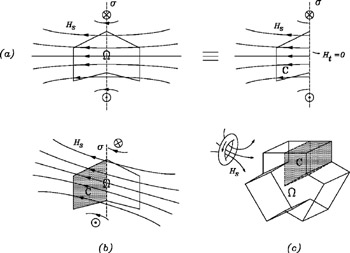
 The problems of electromagnetism often concern symmetric structures. Let us think for example of the stator and rotor of a rotating machine or of a transformer magnetic core. When the sources of excitation share some symmetries, the resolution is simplified by the application of appropriate boundary conditions. Any initial problem is then reformulated on a restricted domain which results in a substantial economy of calculations. This is the case in Figure 9.1a where a symmetric magnetic domain ? with respect to a plane ? is influenced by a source field H s, also symmetric with respect to this plane. It is clear that a study restricted to the "symmetry cell" C is enough to solve the problem provided that the condition of a zero tangent field along ? is imposed. However, such an approach is no longer valid whenever the source fields do not share the symmetry of the domains (Figures 9.1b and 9.1c).
[1]
Nevertheless, it is still possible to take advantage of symmetries of a problem thanks to a linear decomposition similar to Fortescue's method of symmetric components, well-known to electrotechnicians. The principle consists of reducing a given problem in a family of subproblems to be solved on a symmetry cell of the initial problem. The global solution is then obtained by superposition of the partial results and application of symmetry operations. The basis of the method is in the representation theory of finite...