2.1 Formal Definitions of f  g, f
g, f  g
g
In elementary algebra you learned to combine functions f, g by using the binary operations of pointwise addition, subtraction, multiplication, and division, i.e.,
For example, when f, g are functions on  or
or  we define
or
We will use the symbols , for two closely related binary operations, convolution and correlation, that will appear from time to time in the remainder of the book. The purpose of this short chapter is to introduce you to these two new operations that result from the accumulation of certain pointwise arithmetic products.
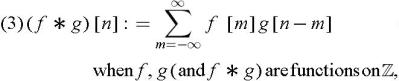
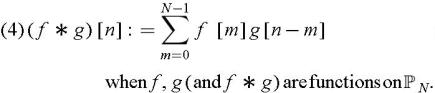
We define the convolution product f g of two suitably regular functions f, g by writing
The integral, sum for computing (f g)(x), (f g)[n] gives the aggregate of all possible products f(u)g(x ?u), f[m]g[n ?m] with arguments that sum to x, n, respectively. We must impose conditions on f, g to ensure that the integral or sum for f g is well defined. For example, when f, g are piecewise continuous functions on we can form f g if one of the functions is bounded and the other is absolutely integrable.
You will observe that (1) (4) give four distinct ways to combine functions f, g, and it would not be inappropriate for us to introduce four distinct symbols, e.g., 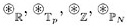 , for the corresponding binary operations. In practice, this proves to be unnecessarily...


 TABLE OF CONTENTS