Introduction
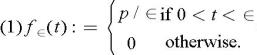
Let y(t) be the displacement at time t of a mass m that is attached to a spring having the force constant k as shown in Fig. 7.1. We assume that the mass is at rest in its equilibrium position [i.e., y(t)=0] for all t ?0. At time t=0 we begin to subject the mass to an impulsive driving force
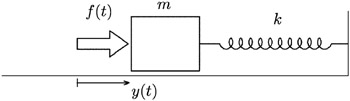 Figure 7.1: An undamped mass-spring system with the displacement function y(t) and the forcing function f(t).
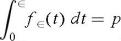
 When the duration  >0 is small, this force simulates the tap of a hammer that transfers the momentum
to the mass and rapidly changes its velocity from y ?(0)=0 to y ?( ) ? p/m.
You should have no trouble verifying that
is a twice continuously differentiable function that satisfies the forced differential equation
for the motion (except at the points t=0, t= ? where  is not defined), see Ex. 7.1. Here
so that sin ( ?t), cos ( ?t) are solutions of the unforced differential equation
Now as ? 0+, the response function (2) has the pointwise limit
and it is natural to think of y 0 as the response of the system to an impulse
of strength
that acts only at time t=0 as illustrated in Fig. 7.2. The physical intuition is certainly valid, and such arguments have been used by physicists and engineers...


 TABLE OF CONTENTS