A First Course in Fourier Analysis, 2nd Edition
Selected Applications

Chapter List

Chapter 8: Sampling
Chapter 9: Partial Differential Equations
Chapter 10: Wavelets
Chapter 11: Musical Tones
Chapter 12: Probability

8.1 Sampling and Interpolation

Introduction

As I speak the word Fourier, a microphone converts the pressure wave from my voice into an electrical voltage f(t), 0 ? t ?.5 sec. The sound card in my computer discretizes this signal by producing the samples


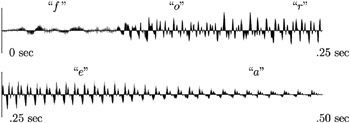
Figure 8.1 shows the (overlapping) line segments joining


Figure 8.1: An audio signal for the spoken word Fourier.

You can identify the hissy initial consonant f , the three long vowels o , e , a (as in boat, beet, bait), and the semivowel r (as in burr).

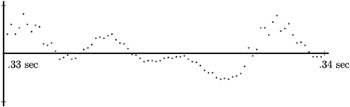
An expanded 80-sample segment of the 10-msec interval .33 sec ? t ?.34 sec (a part of the e sound) is shown in Fig. 8.2. It would appear that we have enough sample points to construct a good approximation to the original audio signal.


Figure 8.2: An 80-sample segment of the e sound from the spoken word Fourier.

In practice, we work with a quantized approximation of the sample f(nT). For example, the Fourier recording uses 1 byte:=8 bits per sample, with one bit specifying the sign of f(nT) and with seven bits specifying the modulus f(nT) to within 1 part in 127 (of some fixed maximum modulus). It takes 4000 bytes of storage for the Fourier recording, more than we need for a...

UNLIMITED FREE
ACCESS
TO THE WORLD'S BEST IDEAS

SUBMIT
Already a GlobalSpec user? Log in.

This is embarrasing...

An error occurred while processing the form. Please try again in a few minutes.

Customize Your GlobalSpec Experience

Category: Sound Cards
Finish!
Privacy Policy

This is embarrasing...

An error occurred while processing the form. Please try again in a few minutes.