A First Course in Fourier Analysis, 2nd Edition

Chapter 5: Operator Identities Associated with Fourier Analysis

5.1 The Concept of an Operator Identity

Introduction

In the preceding two chapters we developed a calculus for finding Fourier transforms of functions on , , , and , and the corresponding rules are succinctly stated in Appendix 3. Each of these rules involves a pair of function-to-function mappings, i.e., a pair of operators. In this chapter we will study these operators and the elementary relations that link them to one another. The change in emphasis will enable us to characterize the symmetry properties associated with Fourier analysis, to deepen and unify our understanding of the transformation rules that we use so often in practice, and to facilitate our study of the related sine, cosine, Hartley, and Hilbert transforms. Later on, we will use operators to describe fast algorithms for computing the DFT, to describe fast algorithms for computing with wavelets, to analyze thin lens systems in optics, etc.

Operators applied to functions on

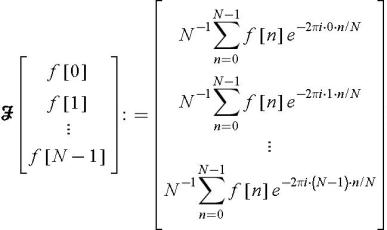
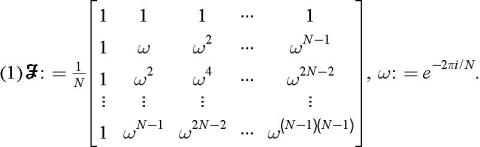
It is easy to illustrate these ideas when we work with functions defined on , i.e., with functions that can be identified with complex N-vectors. From linear algebra we know that any linear mapping can be represented by an N N matrix of complex coefficients. In particular, the discrete Fourier transform operator defined by the analysis equation


is a linear operator that is represented by the N N complex matrix


The reflection operator R, defined by writing


(when we think of f as being an

UNLIMITED FREE
ACCESS
TO THE WORLD'S BEST IDEAS

SUBMIT
Already a GlobalSpec user? Log in.

This is embarrasing...

An error occurred while processing the form. Please try again in a few minutes.

Customize Your GlobalSpec Experience

Category: Fieldbus Products
Finish!
Privacy Policy

This is embarrasing...

An error occurred while processing the form. Please try again in a few minutes.