Friction & Flow Stress in Forming & Cutting
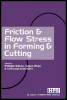
Based on a January 2000 workshop held in Paris, this collection presents studies of friction and flow stress in actual manufacturing processes and methods for modeling friction and wear.
 TABLE OF CONTENTS
 From the experimental results, the following practical conclusions can be drawn.
It was proven that hard coatings are responsible for the changes in friction at the interface with a sliding (cutting) speed commonly used in many machining operations.
The friction force decreases substantially with the rise in the cutting speed and under the contact conditions for which the interface control factor approaches maximum value.
Wide variability is seen in reported values of the friction coefficient for the thin coatings tested on sintered tungsten carbide sliding over the surface of a steel workpiece. The values of ? obtained for coating-on-metal contacts lie in the range from 0.4 to 0.8. These are similar to the values valid for ceramic-ceramic contacts and metallic couples sliding in air in the presence of intact oxide films [HUT 92].
There is considerable interest in the use of Al 2O 3 ceramic as the intermediate layer in multilayered coatings to produce the thermal barrier effect. This is manifested by observation of the four-layer coating for which frictional heat is dissipated effectively at a temperature sufficiently lower than for other tribo-pairs tested.
Both feed rate and cutting speed affect the rate of frictional power dissipation at the interface. In particular, the feed rate was found to act indirectly through the influence on the contact area.
From these conclusions, the friction magnitude can be predicted more reliably for typical CVD-coatings coupled with carbon and austenitic stainless steels.
The data obtained can be used...