Friction & Flow Stress in Forming & Cutting
Based on a January 2000 workshop held in Paris, this collection presents studies of friction and flow stress in actual manufacturing processes and methods for modeling friction and wear.
 TABLE OF CONTENTS
 Stress at the work-piece/die boundary, in both bulk forming and sheet forming, is arguably the single most important physical parameter influencing the processing of metals, yet it remains the least understood parameter; hence the need for basic research into metal-die interface mechanisms. To gain a good understanding of the mechanisms at the interface and to be able to verify the friction and tribology models that exist, friction sensors are needed.
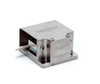
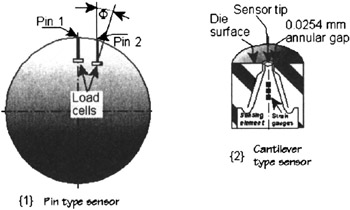
Designing sensors to measure friction in metal working has been pursued by many researchers; see Schey [SCH 83]]. Two types of sensor which are used in laboratories are: (1) the pin-type sensor originally devised by van Rooyen and Backofen [ROO 57] and improved by Al-Salehi [ALS 73] for use in metal rolling and (2) the cantilever friction sensor [BRI 86], see Figure 1. The pin-type sensor {1} measures two forces at the interface, one orthogonal to the rolling direction and the other at an angle to rolling and is specially designed for measuring friction in rolling.; by converting the angular measurement, and comparing it to the normal force, the friction is eventually obtained. The cantilever sensor can be used in other situations, including rolling; it will be discussed in detail later in this chapter.
Other devices which are not reviewed by Schey [SCH 83] but have been tried, are those by Jeswiet...