Fundamental Concepts in the Design of Experiments, Fifth Edition
As we found in Chapter 11, there are many situations in which randomization is restricted. The split-plot design is an example of a restriction on randomization where a main effect is confounded with blocks. Sometimes these restrictions are necessary because the complete factorial cannot be run in one day, or in one environmental chamber. When such restrictions are imposed on the experiment, the researcher must decide what information may be sacrificed, and thus what is to be confounded. A simple example may help to illustrate this point.
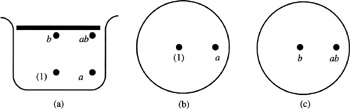
A chemist was studying the disintegration of a chemical solution. He wished to determine whether the depth of the mixture in a beaker would affect the amount of disintegration and whether material from the center of the beaker would differ from material near the edge. He decided on a 2 2 factorial experiment-one factor being depth, the other radius. A cross section of the beaker (Figure 12.1) shows the four treatment combinations to be considered, where A and B are radius and depth, respectively.
In Figure 12.1, (1) represents radius zero, depth at lower level (near bottom of beaker); a represents the radius at near maximum (near the edge of the beaker) and a low depth level; b is radius zero, depth at a higher level; and ab is both radius and depth...