Fundamentals of Acoustics
Focusing on the analysis of acoustics in fluids, this book examines specific types of acoustic propagation in fluid media and the theoretical formulation of the problems rather than their practical aspects.
 TABLE OF CONTENTS
 Even though acoustic dissipation can, in many situations, be ignored (in closed spaces with absorbing walls for example), there are still some cases where one needs to take it into account. Long-distance propagation, even submitted to various perturbations, such as reflection, refraction, diffusion, diffraction etc., and acoustic fields in guides and rigid walled cavities (thus very reflective) are among the examples that generally require consideration of dissipation.
Attenuation of sound waves can result from various processes related to the characteristics of the propagation fluid. For example, the phenomenon of cavitation in liquids (creation and destruction of bubbles by the propagation of an acoustic wave) is a cause of significant attenuation. It is not the purpose of this chapter to present in detail the processes of dissipation in "complex" fluids, but to describe the processes of dissipation that most often occur in "complex" fluids and "simple" fluids (and in gases in particular) where its importance in many real situations is well established. The three considered phenomena are those related to viscosity (shear and volume viscosity), thermal conduction and molecular relaxation (in polyatomic molecules). These processes are introduced in the equations of motions as additional factors. For example, Euler's equation (1.31) is modified by the introduction of a factor expressing the viscosity stresses. This factor is presented as an operator 0 v applied to the particle velocity  (which formula is demonstrated and given in section 2.2),
| (2.1) | 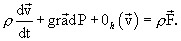 |
However, the mass conservation law (1.29) is not modified
| (2.2) | 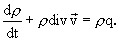 |
The...