Fundamentals of Acoustics

Focusing on the analysis of acoustics in fluids, this book examines specific types of acoustic propagation in fluid media and the theoretical formulation of the problems rather than their practical aspects.
 TABLE OF CONTENTS
 This chapter complements the previous one by providing a comprehensive description of the acoustic motion in fluids initially at rest in the assumption of linear acoustics. The problems and general solutions are presented in curvilinear, cylindrical and spherical coordinate systems. Dissipation is considered, where appropriate, in a similar fashion to that in Chapter 4.
The polar coordinates (r, ?) and the coordinate z constitute the coordinate system. The corresponding unit vectors are respectively denoted  ,
,  and
and  .
.
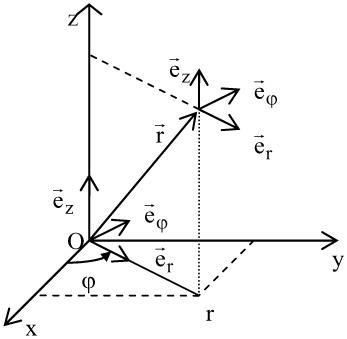
The usual operators take the following forms:
| (5.1) |  |
| (5.2) | 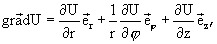 |
| (5.3) |  |
| (5.4) |  |
| (5.5) |  |
| (5.6) |  |
Away from any source, the acoustic pressure satisfies the following equation of propagation:
| (5.7) |  |
The solutions to this equation are assumed to be separable and in the form
| (5.8) |  |
By using the same approach as in section 4.2.2, equations (4.24) to (4.31) and, applying the same logic, the substitution of solution (5.8) into equation (5.7) leads consecutively to
| (5.9) | 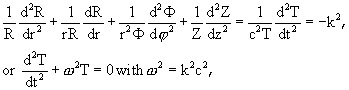 |
| (5.10) |  |
and finally to
| (5.11) |  |
and
| (5.12) | 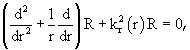 |
where
| (5.13) |  |
is the associated equation of dispersion  .
.
The in-plane "wavenumber component" defined by the polar coordinates and denoted here as k w is independent of the variable r and is given by
| (5.14) |  |
where the three "components" k r, k ? and k z of the wavenumber  are always functions of the quantum number m (unlike the wavenumber
  itself).
By...