Fundamentals of Acoustics
Focusing on the analysis of acoustics in fluids, this book examines specific types of acoustic propagation in fluid media and the theoretical formulation of the problems rather than their practical aspects.
 TABLE OF CONTENTS
 This chapter is a turning point in this book as it introduces the integral formalism for problems in linear acoustics. The integral formalism is equivalent to the differential formalism used in the previous five chapters. The remaining development in this book uses the integral approach extensively and applies it to common situations in acoustics. Integral formalism is based on the decomposition of the acoustic field generated by extended primary sources (real) or secondary sources (reflections) into a sum of elementary fields (Green's functions) generated by (quasi-punctual) source elements. Green's functions therefore play an important role and, even though they have already been briefly introduced in sections 3.3, 3.4 and 5.2.5, the first part of this chapter is dedicated to their properties.
The general problem considered, consisting of modeling a real situation in a domain (D) delimited by a surface (S) (eventually extended to infinity), is limited by the hypothesis of linear acoustics in weakly dissipative media initially at rest. The problem can be written, in the time domain, as:
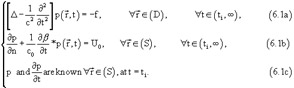
The equation of propagation (6.1a) is the equation (4.1), written in the form (4.13a). By making the hypothesis of null initial conditions, 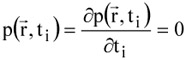 , the same problem in the frequency domain (obtained by Fourier transform) is
| (6.2a) |  |
| (6.2b) |  |
For the sake of simplicity, one notation (p for example) denotes the quantities in both the time domain p(  , t) and the frequency domain p(
  , ?). Also, the factor ? (in equations (6.1) and (6.2))...



