Fundamentals of Acoustics
Focusing on the analysis of acoustics in fluids, this book examines specific types of acoustic propagation in fluid media and the theoretical formulation of the problems rather than their practical aspects.
 TABLE OF CONTENTS
 The methods presented in Chapter 2 are of great importance. It is important to complete the discussion by applying these methods in few examples of acoustic propagation in dissipative fluids. This chapter is entirely dedicated to this.
In addition, this chapter offers the opportunity to study few "classical" problems of acoustics and to introduce important notions and results commonly referred to in practice and throughout this book. The discussions and situations analyzed in all the following chapters will therefore consider the dissipation due to the visco-thermal effects, and sometimes due to the molecular relaxation. Specific conditions on the homogeneity of the fluids, the linearity of the motion, etc. will be considered according to the problem at hand.
The study of acoustic fields in three different domains is presented herein: in a semi-infinite space (or in a very large closed space when compared to the wavelengths considered), in small closed spaces and finally in infinite spaces.
Let a semi-infinite fluid medium be limited by an infinite rigid plane of equation y = 0 (Figure 3.1), the y-axis being orientated positive in the fluid direction.
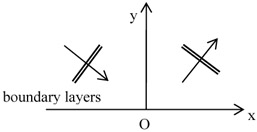
The plane defined by the direction of the incident harmonic plane wave and the axis  normal to the rigid...