Gas Lift Manual
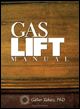
Including ample illustrations to help the reader understand the text, this handy reference is essential to the practicing engineer needing to successfully perform this type of artificial lift project.
 TABLE OF CONTENTS
 Chapter 2 presents a concise treatment of the basic knowledge required from a practicing engineer working on production engineering problems. Production engineering principles and practices related to the design and analysis of artificial lift installations are detailed in depth. The first section discusses the most significant properties of oilfield fluids: oil, water, and natural gas. Since no artificial lift design can be made without the proper knowledge of the oil well's production capability, the section on inflow performance presents a thorough survey of the available methods for describing inflow to oil wells. A separate section deals with the single-phase flow problems encountered in production engineering design. Due to its profound importance, the description of two-phase flow phenomena occupies the largest part of the chapter. Vertical, inclined, and horizontal flow are discussed, and most of the available calculation models for finding the pressure drop in pipes and flow restrictions are presented. After the section on well temperature calculations, the chapter is concluded with a review of the latest tool of the production engineer: the systems analysis approach of evaluating well performance.
The calculation models presented in the chapter are supported by worked examples throughout the text. Later chapters rely on the concepts and procedures covered here, and a basic understanding of this chapter is advised.