Gas Lift Manual
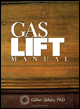
Including ample illustrations to help the reader understand the text, this handy reference is essential to the practicing engineer needing to successfully perform this type of artificial lift project.
 TABLE OF CONTENTS
 In order to maintain proper operation of a gas lift installation, its operating conditions must frequently be evaluated. In case of deviations from design conditions, appropriate corrective actions have to be taken. Usually, the analysis is started by calculation of operational parameters valid for the original design conditions. Then, using available diagnostic techniques, actual parameters are measured or calculated and compared to those under design conditions. After diagnosing the deviations from ideal conditions, the possible sources of operational problems can be detected and corrective actions can be recommended. This kind of troubleshooting is described in this chapter.
The analysis of operational conditions must always be based on sound and recent data. General data to be determined and usually available for each installation without any specific diagnostic measurements can be grouped as given as follows:
Fluid properties include the basic parameters (densities, viscosities, etc.) of oil, water and gas as well as bubblepoint pressure, formation GOR, water cut, etc.
Reservoir data cover the description of inflow performance of the given well and a recent set of parameters (static reservoir pressure, PI, etc.) must be available.
Data of a recent well test (preferably a 24-hour production test) should be available and should include volumetric rates of oil, water, and total (injection plus formation) gas produced.
Well completion data include casing, tubing sizes, running depths, well deviation, perforation data as well as surface geometrical data on the flowline, gas injection line, and the wellhead.
Gas lift equipment data are related to the running...