Gas Lift Manual
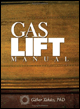
Including ample illustrations to help the reader understand the text, this handy reference is essential to the practicing engineer needing to successfully perform this type of artificial lift project.
 TABLE OF CONTENTS
The fluids most often encountered in oil well production operations are hydrocarbons and water. These can be either in a liquid or gaseous state depending on prevailing conditions. As conditions like pressure and temperature change along the flow path (while fluids are moving from the well bottom to the surface), phase relations and physical parameters of the flowing fluids continuously change as well. Therefore, in order to determine operating conditions or to design production equipment, it is essential to describe those fluid parameters that have an effect on the process of fluid lifting. In the following, calculation methods for the determination of physical properties of oil, water, and natural gas are detailed.
Naturally, the most reliable approach to the calculation of accurate fluid properties is to use actual well data. Collection of such data usually involves pressure-volume-temperature (pVT) measurements and necessitates the use of delicate instrumentation. This is why in the majority of cases, such data are not complete or are missing entirely. In these cases, one has to rely on previously published correlations. The correlations presented in this section help the practicing engineer to solve the problems that insufficient information on fluid properties can cause. The reader is warned, however, that this is not a complete review of available methods, nor are the procedures given superior by any means to those not mentioned. Our only aim is to give some theoretical background and practical methods for calculating oilfield fluid properties. This goal...