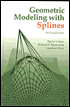
Geometric Modeling with Splines: An Introduction
In the various branches of mathematics, science, and engineering which use curves and surfaces, there are many formulations which occur in every day use. Each has attributes which might be desirable for different parts of the modelling or analysis process; each has drawbacks. In this chapter we investigate some of the more well-known choices. Later chapters might involve blends in which some work is initially defined in one representation and then converted to another. The interrelationship possible among them affects the conversions possible.
When one represents a curve or surface as part of the modelling process, this is a different problem than representing a curve derived from many physical experiments, or even from the clear cut mandate present in numerical analysis to fit a curve with certain abscissas and ordinates. The problems inherent in modelling are many. One problem is that there is frequently no natural coordinate system for the situation. Certain symmetries of one part of the object to be modelled might dictate one particular choice of direction to represent the axes, while symmetries of another part of the same object might dictate another totally different choice of direction. For one part of the problem a certain choice of units might be natural, but for another part a totally different scale might be appropriate.
Another part of the design might involve fitting a curve or surface to certain predetermined points or to a certain predetermined shape in space. Since a shape is not determined by the particular orientation...