Geometric Modeling with Splines: An Introduction
In this chapter we study curves which are linear combinations of B-spline basis functions. We shall derive the properties of these curves. In addition, we develop the property which underlies most subdivision curve and surface algorithms as a property of uniform B-spline curves. We shall use the notation of the previous chapter and briefly review the most important definitions. Let u = { u i} denote a collection of distinct values, and m = { m i} denote a set of positive integer values, one for each element of u. Define a nondecreasing sequence of real numbers t = { t j} such that m i = card{ t j : t j = u i}, and t j ? t j +1. u and t can be infinite or finite.
Suppose that N + 1 =
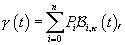
m i, that is, t has N + 1 elements. Then there are exactly N - ? basis functions of degree ?. The linear combinations of these basis functions can be written
where n = N - ? - 1. While it is somewhat confusing, it is a current convention to call the functions
B-splines while calling linear combinations of them B-spline curves or B-spline expansions.
Consider
, the collection of all linear combinations of the modified normalized B-splines of degree ? over...