Once the general theory and the general algorithms are known, they must be interpreted and made practical for use in design. While the possible spaces of curves are very general, there is no theoretical method for determining which ones are feasible in particular design situations. In this chapter approaches are presented for fitting to a pre-existing primitive either data or function. We present interpolation techniques, including complete spline interpolation, nodal interpolation, and piecewise Hermite interpolation, all with the B-spline basis. We also include approximation techniques, such as quasi-interpolation, least squares, and the Schoenberg variation diminishing approximation. We touch on B-spline wavelets in the section on multiresolution curve decomposition and editing.
9.1 Interpolation with B-Splines
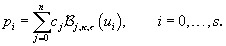
One widely used form of data fitting is interpolation. Sometimes the problem is to interpolate to positional data alone, and sometimes it is necessary to interpolate to derivatives as well as position, at least at some of the points. We can state the general problem over a spline space S ? , ? First, however, consider a collection of s + 1 data pairs, 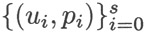 . The position interpolation problem in the space S ? , ? is to find values for coefficients c j, such that
In general, suppose that at u i, it is necessary to interpolate the value p i and its first r i derivatives. That is, the interpolation problem is to find coefficients c j such that
 means this data value represents...
Copyright A K Peters, Ltd. 2001 under license agreement with Books24x7

 TABLE OF CONTENTS