The Global Technology Revolution: Bio/Nano/Materials Trends and Their Synergies With Information Technology By 2015

New materials can often be critical enabling drivers for new systems and applications with significant effects. However, it may not be obvious how enabling materials affect more observable trends and applications. A common process model from materials engineering can help to show how materials appear likely to break previous barriers in the process that ultimately results in applications with potential global benefits.
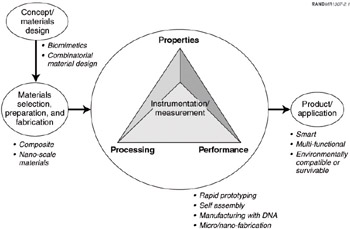
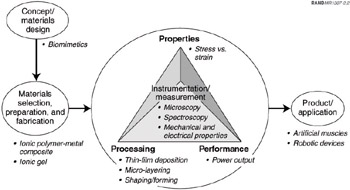
Developments in materials science and engineering result from interdisciplinary materials research. This development can be conveniently represented by the schematic description of the materials engineering process from concept to product/application (see Figure 2.1). This process view is a common approach in materials research circles and similar representations may be found in the literature (see, for example, National Research Council, 1989 [123], p. 29). Current trends in materials research that could result in global effects by 2015 are categorized below according to the process description of Figure 2.1. Figure 2.2 provides an example of the development process in the area of electroactive polymers for robotic devices and artificial muscles.
Biomimetics is the design of systems, materials, and their functionality to mimic nature. Current examples include layering of materials to achieve the hardness of an abalone shell or trying to understand why spider silk is stronger than steel.
Combinatorial materials design uses computing power (sometimes together with massive parallel experimentation) to screen many different materials...