Green BIM : Successful Sustainable Design with Building Information Modeling

Energy Modeling

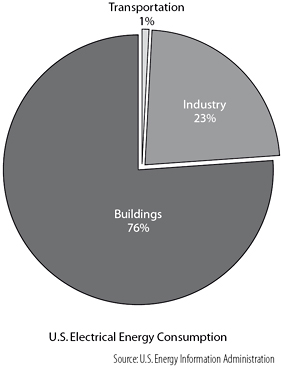
Understanding a building s energy needs is paramount to helping the project become more sustainable. According to the U.S. Energy Information Administration, buildings in the United States account for 30% of the world s energy and 60% of the world s electricity, making the United States the primary consumer of energy in the world and the built form the largest consumer (Figure 6.12). That gives us a large burden to build responsibly and think about our choices before we implement them.


Figure 6.12: United States energy use

The energy needs of a building depend on a number of issues that are not simply related to leaving the lights on in a room that you are no longer using or turning down the heat or upping the air-conditioning. Many of the systems within a building revolve around the energy use. For instance, if you increase the windows on the south fa ade, you allow in more natural light and lower your need for electric illumination. However, without proper sunshading, you are also letting in additional solar heat gain with those larger windows, thus increasing your need for more air-conditioning and potentially negating the energy savings from lighting.

In exploring the use of energy in a building, all energy-related issues must be taken into account, and this is why we use energy simulation. These computer-based models use climatic data coupled with building loads, such as:

  • The heating, ventilation, and air-conditioning system (HVAC)

  • Solar heat gain

  • The number of...

UNLIMITED FREE
ACCESS
TO THE WORLD'S BEST IDEAS

SUBMIT
Already a GlobalSpec user? Log in.

This is embarrasing...

An error occurred while processing the form. Please try again in a few minutes.

Customize Your GlobalSpec Experience

Category: Energy Use Consulting Services
Finish!
Privacy Policy

This is embarrasing...

An error occurred while processing the form. Please try again in a few minutes.