Green Building Through Integrated Design
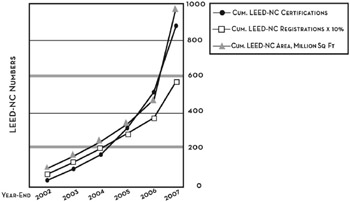
Green buildings and sustainable design have been major movements in the design, development and construction industry since about 2000, with an accelerating interest since 2005, as shown in Fig. 2.1. Here we see the growth of green buildings, in terms of cumulative LEED project registrations and certifications, both increasing 75 percent in 2007 alone, and 65 percent and 77 percent, respectively, in 2006 versus the prior year. In this respect, the acceptance and practice of green building design, after growing steadily from 2000 through 2005, began accelerating in 2006 and 2007.
However, a large majority of such projects are still at a basic level of green design, as shown by the number of LEED Certified and Silver projects, as a percentage of the total. By the end of the first quarter of 2008, total LEED for New Construction and Major Renovations (LEED-NC) project certifications (U.S. projects only) numbered 1015 (including the four major systems LEED for New Construction and Major Renovations, LEED for Core and Shell, LEED for Commercial Interiors, and LEED for Existing Buildings: Operations and Maintenance, total certifications were 1405). Table 2.1 shows the relative percentage of high-performance LEED-NC certifications (Gold and Platinum) represent about 32 percent of the total, with Platinum representing some 50 U.S. projects, or 5 percent of the total. Based this analysis, I decided to focus this book primarily on the Platinum projects, since they represent the highest attainment level in the LEED system and are still relatively...