Green Building Through Integrated Design
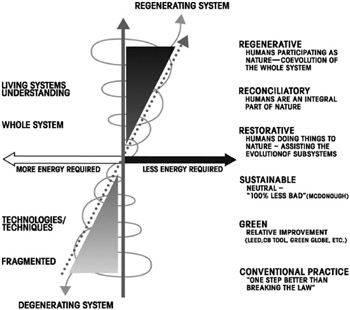
Along with many others, Bill Reed writes about the need to continue the push for high-performance buildings into the realm of restorative and regenerative design. In a 2005 paper, Reed (and his coauthors) wrote: the term regenerative is useful because it suggests the self-organizing, self-healing and self-evolving properties of living systems. [ ] Rather than green design (as LEED defines it), where the goal is just to reduce the damage by being less bad, and even fully sustainable design, where the goal is to evaluate our impacts against a goal of zero harm, the spirit of regenerative design envisions a trajectory of responsible design (Fig. 14.1) that aims to restore living systems to a more productive level than we found them, all the while maintaining a prosperous and healthy human existence. Quite a tall order!
One step along the way to fully regenerative design is to create a living building. [*] Jason McLennan, currently CEO of the Cascadia Chapter of the U.S. Green Building Council, is a serious advocate for this concept. In a brilliant twist on the LEED-NC system, with its seven prerequisites and 69 credit points, often criticized for allowing buildings to be certified with only marginally better energy performance, for example, McLennan postulated a rating system, the Living Building Challenge (LBC), that...