Green Chemistry: An Introductory Text

Chapter 2: Waste: Production, Problems and Prevention

In an ideal chemical factory there is, strictly speaking, no waste but only products. The better a real factory makes use of its waste, the closer it gets to its ideal, the bigger is the profit.

A. W. von Hofmann (First President of The Royal College of Chemistry, London) 1848

2.1 INTRODUCTION

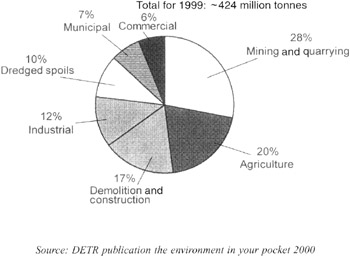
Waste is a natural consequence of all human activity including the actual process of living; the average adult produces over 300 g of faeces and 1 1 of urine per day. In the UK, however, sewage sludge accounts for less than one per cent of the total waste produced. Mining and agriculture together account for almost 50% of waste production (Figure 2.1) but industry and commerce account for a further 18% - some 76 million tonnes per annum.


Figure 2.1: Sources of waste in the UK Approx. 1999 total 424 million tonnes

The problems posed by waste, including the inefficient use of resources and capital, together with the risks to welfare and the environment are widely recognized by most sectors of society. Many countries now have active programmes to reduce the amount of waste disposed of to land, air and water through increased recycling and deploying waste minimization initiatives. An accepted hierarchy for waste management has been developed (Figure 2.2) with the most preferred solution being reduction of waste at source. Lower down the hierarchy comes re-use, followed by recycling to recover materials and/or energy. Disposal of treated or untreated waste should only be considered as a...

UNLIMITED FREE
ACCESS
TO THE WORLD'S BEST IDEAS

SUBMIT
Already a GlobalSpec user? Log in.

This is embarrasing...

An error occurred while processing the form. Please try again in a few minutes.

Customize Your GlobalSpec Experience

Category: Solid Waste Management and Treatment Services
Finish!
Privacy Policy

This is embarrasing...

An error occurred while processing the form. Please try again in a few minutes.