Green Chemistry: An Introductory Text

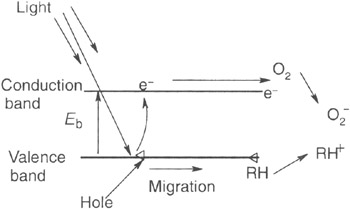
Photocatalysis usually refers to the activation of semiconductors by light; light is not acting as a catalyst but as a source of energy to activate the catalyst. When light of a suitable wavelength falls on a semiconductor it may promote an electron from the valence band to the conduction band (Figure 4.6). For this to happen the photon must have an energy greater than the band gap energy, E b. The result of this is that positive holes are generated in the valence band which may migrate to the surface and act as strong oxidizing agents. Titanium dioxide is the most popular semiconductor used because the band gap energy (3.2 ev) is highly accessible by UV light.
Because of the strong oxidizing potential of photocatalysts in the presence of oxygen and water they are generally not good catalysts for the synthesis of chemicals, but they are capable of catalysing the complete mineralization of a range of organic materials. Well over 200 organic compounds have been shown to undergo complete mineralization according to Equation 4.5. Heteroatoms such as chlorine or sulfur are converted to the corresponding mineral acid during the process. This process has huge potential for both in situ waste treatment and pollution clean-up.
| (4.5) | |
Japanese companies have pioneered a number of interesting and valuable commercial applications. Cleaning windows is time consuming and wasteful of water, and can be relatively dangerous when dealing with high tower blocks. By adding a...