Green Chemistry: An Introductory Text

Chapter 6: Renewable Resources

6.1 BIOMASS AS A RENEWABLE RESOURCE

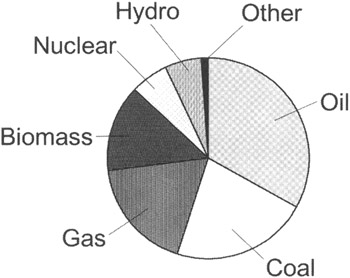
All living material may be considered as biomass, but commonly only non-animal renewable resources such as trees and crops, which may be harvested for energy or as a chemical feedstock, tend to be referred to as biomass. Although the total amount of biomass available at any one time is relatively small, some estimates putting the figure at under 2000 billion tonnes (including water contained in the cells), unlike fossil resources it is readily renewable on a timescale useful to mankind. The energy for this renewal process comes from the sun, with around eight times our annual energy consumption (>350 10 18 J) being fixed each year through photosynthesis. This is equivalent to the generation of some 70 10 9 tpa of organic matter. For most of the history of mankind biomass was the only source of energy, and even with our current heavy reliance on fossil fuels, biomass still accounts for just under 15% of the world's energy use (Figure 6.1). This use is heavily concentrated in developing countries like India and southern Africa but many well-forested developed countries still use significant amounts of wood for burning.


Figure 6.1: Sources of world energy

6.2 ENERGY

6.2.1 Fossil Fuels

The era of society's almost total dependence on fossil resources will come to an end during the twenty-first century. This is the startling conclusion now being reached by a growing number of experts. Indeed, as far as oil is concerned, many now...

UNLIMITED FREE
ACCESS
TO THE WORLD'S BEST IDEAS

SUBMIT
Already a GlobalSpec user? Log in.

This is embarrasing...

An error occurred while processing the form. Please try again in a few minutes.

Customize Your GlobalSpec Experience

Category: Fuels and Fuel Products
Finish!
Privacy Policy

This is embarrasing...

An error occurred while processing the form. Please try again in a few minutes.