Green Chemistry: An Introductory Text

In this chapter some examples of green chemical technology which have met with commercial success are discussed. The examples have been chosen to reflect a cross-section of both the industry and the wide variety of applications in which chemicals are used.
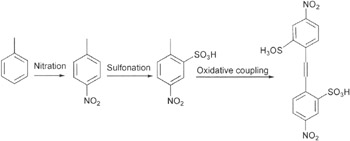
Hickson & Welch have been producing fluorescent brightening agents for many years. In the early 1990s, driven by concerns over process effluent, particularly VOCs, and the associated end-of-pipe treatment cost, the company initiated work to improve process efficiency through waste minimization.1 The stilbene-based optical brighteners being produced have been used since the 1950s to give the 'whiter than white' look to textiles and are also used extensively in the paper industry. These materials, of which there are several variants, are a true speciality chemical being produced at the 100 000 tpa scale. The traditional production chemistry is classical, using methods developed in the 1950s. The first stage of the process involves nitration of toluene with a mixture of sulfuric and nitric acids and subsequent sulfonation with oleum. Oxidative coupling of 4-nitrotoluene sulfonic acid, in a basic solution, with a manganese catalyst and air forms the stilbene group (Scheme 9.1).

These three steps all produce significant amounts of waste. First, as discussed earlier, the nitration process results in the production of spent sulfuric acid. In the past the company had been able to sell much of this material to the coke and steel industries but...