Grinding Technology: Theory and Applications of Machining with Abrasives, Second Edition
5.3: GRINDING FORCES, POWER, AND SPECIFIC ENERGY

5.3 GRINDING FORCES, POWER, AND SPECIFIC ENERGY

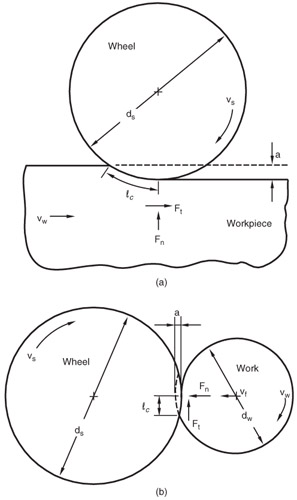
Forces are developed between the wheel and the workpiece owing to the grinding action. For plunge grinding operations, as illustrated in Figure 5-2 for straight surface and external cylindrical grinding, the total force vector exerted by the workpiece against the wheel can be separated into a tangential component F t and a normal component F n. For shallow cut surface grinding with small depths of cut, the tangential force component is oriented very close to the horizontal direction and the normal force very close to the vertical direction, as shown in Figure 5-2 (a), because the line of action of the total force between the wheel and the workpiece are very close to the location on the wheel periphery directly below the wheel axis. However this 'approximation' may not apply with large depths of cut, such as typical of creep feed grinding, since the force line of action would be further moved along the contact length [11]. For grinding with non-symmetrical profiles or with traverse, there would also be an additional force component in a direction parallel to the wheel axis.


Figure 5-2: Illustration of force components for plunge grinding.

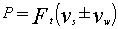
The grinding power P associated with the force components in Figure 5-2 can be written as

(5-1)

The plus sign is for up-grinding with the wheel and workpiece velocities v s and v w in opposite directions at the grinding zone as in Figure 5-2, and the...

UNLIMITED FREE
ACCESS
TO THE WORLD'S BEST IDEAS

SUBMIT
Already a GlobalSpec user? Log in.

This is embarrasing...

An error occurred while processing the form. Please try again in a few minutes.

Customize Your GlobalSpec Experience

Category: Precision Grinding Services
Finish!
Privacy Policy

This is embarrasing...

An error occurred while processing the form. Please try again in a few minutes.