Grinding Technology: Theory and Applications of Machining with Abrasives, Second Edition

5.9: EMPIRICAL RELATIONSHIPS

5.9 EMPIRICAL RELATIONSHIPS

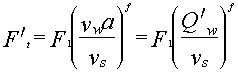
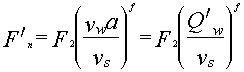
Our objective in this chapter has been to present a physical description of the grinding process, which can account for the magnitude of the forces and energy. Other more empirical approaches have attempted to correlate grinding behavior with 'basic' process parameters. With cylindrical plunge grinding, for example, it has been shown that the tangential and normal force components per unit width may be fairly well approximated by power function relationships [77]:

(5-36)

and

(5-37)

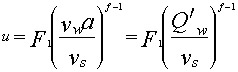
where F 1, F 2 and f are constants. The exponents are typically in the range 0.4 0.9. The corresponding specific energy from Eq. (5-3) is

(5-38)

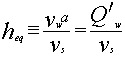
The quantity within the parentheses in Eqs. (5-36) (5-38) is called the equivalent chip thickness

(5-39)

the name being given because it would correspond to the thickness of a continuous layer of material (chip) being removed at a volumetric rate per unit width Q' w and cutting velocity v s. This parameter is also equal to the volumetric removal rate per unit area of wheel surface passing through the grinding zone. As a relative measure of grinding severity, the equivalent chip thickness correlates fairly well not only with the grinding forces and energy, but also with other performance characteristics including surface roughness and wheel wear, as will be seen in Chapters 10 and 11. However, these and other empirical relationships tend to be of limited practical use for predicting grinding performance because the constants F 1, F 2 and

UNLIMITED FREE
ACCESS
TO THE WORLD'S BEST IDEAS

SUBMIT
Already a GlobalSpec user? Log in.

This is embarrasing...

An error occurred while processing the form. Please try again in a few minutes.

Customize Your GlobalSpec Experience

Category: Precision Grinding Services
Finish!
Privacy Policy

This is embarrasing...

An error occurred while processing the form. Please try again in a few minutes.