Grinding Technology: Theory and Applications of Machining with Abrasives, Second Edition
Most grinding operations are performed with the aid of a grinding fluid. Grinding fluids are generally considered to have two main roles: lubrication and cooling. Grinding fluids can also help to keep the wheel surface clean and provide corrosion protection for newly machined surfaces. Lubrication by grinding fluids reduces the friction and wear associated with the grinding process, thereby allowing for more efficient operation with less consumption of the abrasive, as will be seen in Chapter 11. Cooling by the fluid within the grinding zone is especially critical for creep-feed operations and also for many grinding operations with CBN wheels, as seen in Chapters 7 and 8. Bulk cooling of the workpiece by the applied fluid decreases the inaccuracies associated with thermal expansion and distortion of the workpiece.
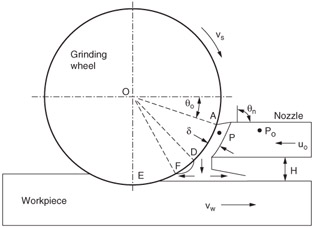
Grinding fluids are usually applied from a nozzle as illustrated in Figure 9-1. The rotating grinding wheel serves as a pump to transport part of the applied fluid through the grinding zone. Furthermore, fluid entrained within the converging wedge formed between the wheel and the workpiece at the entrance to the grinding zone may generate hydrodynamic forces, especially when operating at high wheel speeds with non-porous wheels (e.g. resin and metal bonded superabrasive wheels). Hydrodynamic forces are generally not a problem with porous (vitrified) wheels, although the rough wheel surface interacting with the fluid may consume a significant amount of power especially when operating at high wheel speeds.
This chapter...