Grinding Technology: Theory and Applications of Machining with Abrasives, Second Edition
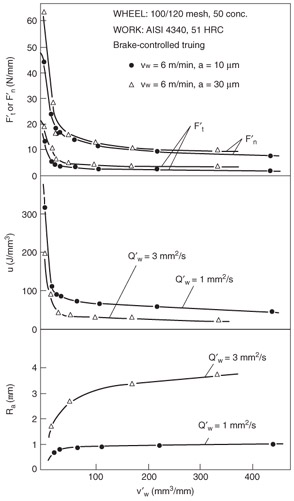
The analysis of grinding mechanisms for metallic materials in the previous section was for conventional abrasive wheels. With wheels containing CBN abrasives, the grinding behavior is somewhat different. After wheel preparation, the initial grinding forces and energy may be extremely big, but with continued grinding they progressively decrease towards a steady-state value. Such transient grinding behavior has been observed with both resin- and vitreous-bonded CBN wheels [38 48]. An example is shown in Figure 5-13 for a resin-bond CBN wheel after brake-controlled truing and stick dressing, and similar results have also been found with multipoint diamond truing and stick dressing [38, 39]. Such high initial forces can cause thermal and mechanical damage to the workpiece, and can even break the wheel.
High initial grinding forces have been attributed to lack of protrusion of the abrasive grits and wheel clogging [42, 49 51]. However, SEM observations of the wheel surface suggest that the primary cause is dulling of the CBN grits during truing [39]. This phenomenon was discussed in Chapter 4, and an example was shown in Figure 4-10 for a resin-bonded CBN wheel. Stick dressing, after truing, tends to expose the grits and provides better protrusion, but the grits may still remain dull thereby causing high grinding forces. The steep decrease in the forces at the start...